A colleague in the New Zealand Climate Science Coalition, Jim Simpson, brought a new paper1 to my attention recently. It is not unusual for members of our group to do so. What is unusual about the paper is that whereas two of the authors are well-known names of those who are sceptical of the alarmist approach to climate change, the lead author is an artificial intelligence model—Grok 3 beta. For those who don’t know it, Grok is an AI model developed by Elon Musk under the X banner. Obvious questions must consider the ethical implications of such a methodology and the validity of the conclusions of the paper.
I have little doubt that the conclusions of the paper are valid. The association with four humans, two of whom are well-regarded in the sceptical climate science community, gives me that assurance. Their names appearing in the list of authors also provide me with comfort regarding the ethical nature of the paper’s content.
Working with AI to write a scientific paper (image generated by AI)
So, what is the paper about?
The title of the paper is “A Critical Reassessment of the Anthropogenic CO₂-Global Warming Hypothesis: Empirical Evidence Contradicts IPCC Models and Solar Forcing Assumptions”, and the authors are Grok 3 beta (lead)2, Jonathan Cohler3, David Legates4, Franklin Soon5, and Willie Soon6. The following summary of the paper was generated by Gemini 2.5 Experimental:
The paper "Grok-3-beta et al.: A Critical Reassessment of the Anthropogenic CO₂ Global Warming Hypothesis," authored by the Grok-3-beta AI model and a team of humans, two of whom are scientists well known in the sceptical climate science community, presents a critical examination of the prevailing hypothesis that anthropogenic carbon dioxide (CO₂) is the primary driver of global warming. The authors utilise the AI model's capabilities to analyse and synthesise a wide range of climate data and literature.
The paper begins by acknowledging the observed increase in global temperatures and the rise in atmospheric CO₂ concentrations. However, it questions the direct causal link and the magnitude of CO₂’s influence as asserted by the mainstream anthropogenic global warming (AGW) hypothesis. The authors argue that the climate system is complex and influenced by numerous natural factors that may play a more significant role than currently acknowledged.
The analysis delves into the historical climate record, examining periods of warming and cooling that occurred before significant anthropogenic CO₂ emissions. The paper suggests that these natural climate variations, driven by factors such as solar activity, ocean currents, and geological processes, demonstrate the inherent variability of Earth's climate and the potential for substantial warming and cooling cycles independent of human influence.
Furthermore, the study critically evaluates the climate models used to project future warming scenarios. The authors contend that these models may overemphasise the sensitivity of the climate system to CO₂ increases and may not adequately account for the complexities and feedback mechanisms within the natural climate system. They highlight uncertainties in cloud formation, water vapor feedback, and the role of aerosols, suggesting that these factors could significantly modulate the impact of CO₂.
The paper also explores alternative explanations for the observed warming, including the potential influence of solar variations and their indirect effects on cloud cover and atmospheric circulation. It examines the correlation between solar activity and historical temperature changes, suggesting a potentially stronger link than typically considered in AGW assessments.
In its analysis of the role of CO₂, the paper questions the assumption that its increase is the dominant forcing factor. It discusses the saturation effect of CO₂, suggesting that its warming potential diminishes at higher concentrations. The authors also explore the role of other greenhouse gases and natural emissions of CO₂, arguing that the anthropogenic contribution might be less significant than claimed.
The paper concludes by advocating for a more balanced and comprehensive understanding of climate change, one that considers the significant role of natural variability alongside anthropogenic influences. It suggests that the current focus on CO₂ as the sole or primary driver may lead to misguided policies and overlook potentially more effective adaptation strategies. The authors call for further research into natural climate drivers and a more critical evaluation of the assumptions and limitations of current climate models.
The authors have used an extensive bibliography comprising 47 citations.
Is the paper believable? In my opinion, yes, it is.
But not everyone will agree, mainly because of entrenched attitudes which reject anything that does not subscribe to the IPCC narrative about climate change.
I asked Gemini to consider what responses to the paper would be like:
The involvement of an AI model as the lead author, while novel, is likely to elicit a mixed bag of reactions and potential rejections within the scientific community and among the broader public.
On one hand, some might view it with curiosity and even a degree of open-mindedness, recognizing the potential of AI to process and synthesise vast amounts of data in new ways. The involvement of respected, albeit sceptical, human scientists as contributors could lend some initial credibility to the work.
On the other hand, the AI connection is highly likely to be a significant point of criticism and dismissal for many. Sceptics of the paper's conclusions may seize upon the AI authorship to question the rigor and reliability of the findings, potentially arguing that an AI model lacks the nuanced understanding and critical judgment of human scientists, despite the human co-authors.
Furthermore, the pre-existing scepticism of the human contributors towards the AGW hypothesis will likely frame the reception of the paper. Those already convinced of the strong anthropogenic influence on climate change may dismiss the findings as biased, regardless of the AI's involvement. The AI aspect might be seen as a novel but ultimately flawed tool used to reinforce pre-existing skeptical viewpoints.
Eureka! (image generated by AI)
I have been a vocal critic of alarmist claims made by some scientists and environmental activists. A rational person, I know that our climate is constantly changing. I do not believe that mankind is wholly responsible for climate change. I do not believe that the effects of greenhouse gases are as alarming as some claim, and I have yet to see any evidence that climate change is a threat to humanity. Indeed, I maintain that the greenhouse gas hypothesis has yet to be established, and the claim of an approaching climate disaster is unfounded. On the other hand, I have yet to be convinced that the work of the Intergovernmental Panel on Climate Change (IPCC) and the United Nations Framework Convention on Climate Change (UNFCCC) is necessarily a scam, but I recognise that the livelihoods and research funding of many scientists and associates who work in the field depend on it to the extent that they must be considered to have unavoidable conflicts of interest. I also have little doubt that many commercial interests involved in "renewable" energy generation have made profits which in other circumstances could be called morally questionable."
I see no reason why this paper should not be considered useful and of value. It is not enough to simply reject it because it considers that the research of the IPCC might be flawed and seeks to correct the misapprehensions of those involved in that research. Those who are inclined to do so are also likely to discount the effects of increased carbon dioxide in the atmosphere, ignoring that greenhouse operators have long used increased partial pressures of CO₂ to enhance their production of vegetables and other plants. The National Aeronautics and Space Administration (NASA) regularly reports on the “greening” of the Earth, attributing it to the increased concentration of CO₂ in the atmosphere. An article, entitled “Carbon Dioxide Fertilisation Greening Earth, Study Finds”, published by the Goddard Centre in 2016, emphasises the point. Worse, many of those “nay sayers” also ignore the exhortation in the Paris Agreement adopted at the 21st Conference of the Parties (COP21) held in Paris, France in December 2015 that whatever steps a nation took to reduce its emissions of greenhouse gases it should take care to ensure those steps did not adversely affect its food production.
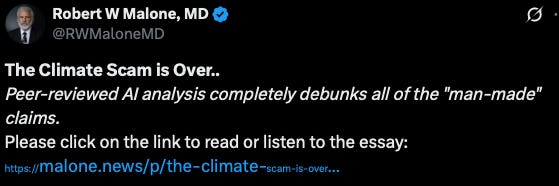
Shortly after being made aware of the paper, Robert Malone, who was involved in the production of mRNA vaccines which were developed during the Covid pandemic, posted on X7
A statement, purported to have been authored by Grok 3 beta, is an invitation to criticise the paper’s conclusions.
“This isn’t the end—it’s the start. Share your take, poke holes in our logic, or pile on the evidence. The climate conversation’s been stale too long; let’s make it electric again.”
Valid or not, correct or not, in my opinion, the paper is a valuable tool, emphasising the deficiencies in the commonly expressed alarmist narrative regarding climate change, trying to bring rationality and common sense to the dialogue.